Regarding the Serious Threat of Execution of Death Sentences Against Six Arab Political Prisoners of Ahwaz

Urgent Statement of the Ahwazi Centre for Human Rights
Regarding the Serious Threat of Execution of Death Sentences Against Six Arab Political Prisoners of Ahwaz
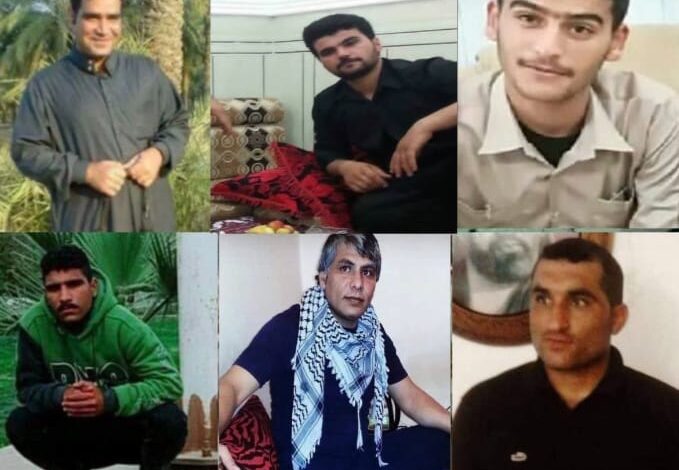
The Ahwazi Centre for Human Rights expresses its deep concern over the imminent threat of execution of death sentences against six prisoners from the Arab of Ahwaz. These individuals, who have been detained for several months by security agencies affiliated with the governmental apparatus, have faced severe sentences without access to transparent and fair judicial procedures. Recent reports indicate that some of them have been transferred to solitary confinement in Sheiban Prison in Ahwaz — which is directly controlled and supervised by these agencies — an action that may signal a serious move toward the imminent execution of these sentences.
These developments come as on Tuesday, October 16, 2024 (24 Mehr 1403), the security guards of Ahwaz Central Prison (Sheiban) transferred three Arab political prisoners named Ali Mojadam, Moein Khanafri, and Mohammadreza Moghadam to solitary confinement in Sepidar Prison. This action, carried out under the pressure of security agencies affiliated with the government, is seen as a clear indication that the execution of the death sentences against these individuals is imminent.
Earlier, these three, along with two other prisoners named Habib Drees and Salem Mousavi, were tried and sentenced to death under security forces’ supervision in conditions completely contrary to fair trial standards, accused of involvement in the killing of military personnel. Their arrests in 2017 and 2018 (years 1396 and 1397) by these agencies in Ahwaz and neighboring cities occurred without any access to independent lawyers, family contact, or basic legal support.
The entire process of imprisonment, interrogation, and trial of these prisoners has been marked by blatant violations of fundamental human rights. They have endured prolonged detention periods under severe psychological and physical pressure and were subjected to torture to extract confessions that lack any legal validity. Nevertheless, the judicial system, in coordination with security agencies, has issued death sentences solely based on these forced confessions—an act clearly at odds with recognized principles of justice, fair trial standards, and international obligations.
Among these six prisoners, the case of Mohammadreza Moghadam is a clear example of the multifaceted pressures not only on the prisoners themselves but also on their families. Despite the fact that the cases are based on confessions obtained under torture and fabricated accusations, recently families introduced as heirs by the judiciary have contacted Mr. Moghadam’s family demanding a payment of five billion tomans in exchange for forgiveness.
Meanwhile, Mr. Moghadam’s family, due to economic pressures caused by discriminatory employment policies prioritizing non-local forces in Ahwaz, are unable to pay this amount and have been forced to issue a public appeal to raise the blood money.
This situation reflects the additional oppressive pressure imposed by security and judicial agencies through unfair methods on families whose loved ones have been targeted solely for their civil activism and demands for human rights. These families face not only constant anxiety about their relatives’ fate but also severe economic hardships and psychological stress.
Ahwazi Centre for Human Rights emphasizes that the charges against these prisoners are fundamentally fabricated, lack any legal basis, and have emerged within a security and repressive environment. Security and judicial bodies exploit ambiguous and non-transparent methods to criminalize the civil protests and legal demands of the Arab people of Ahwaz and to silence critical voices.
Accordingly, this center calls upon all international human rights organizations, UN special rapporteurs, NGOs, and governments committed to human dignity to use all available means to immediately halt the executions, conduct independent investigations into torture allegations, and guarantee these prisoners’ access to their basic rights, including independent legal counsel, medical care, and communication with their families.
26 September 2025 / 4 Mehr 1404
Ahwazi Centre for Human Rights
https://acfh.info